
Review: Downliners Sect - The Country Sect (1965)

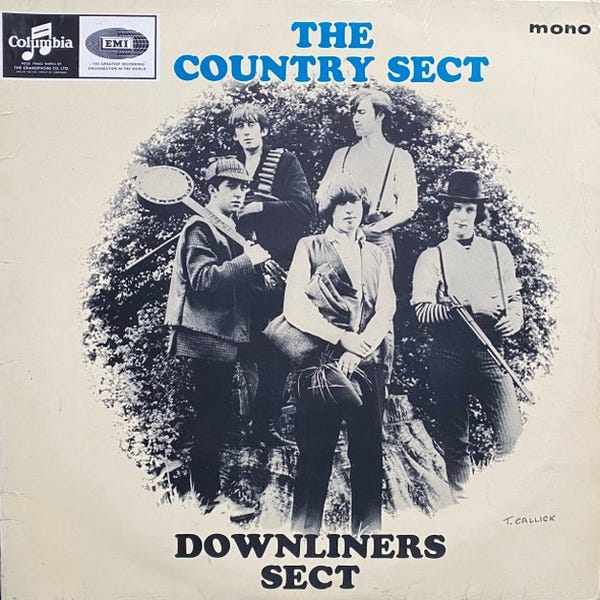
Tracks: 1) If I Could Just Go Back; 2) Rocks In My Bed; 3) Ballad Of The Hounds; 4) Little Play Soldiers; 5) Hard Travellin’; 6) Wait For The Light To Shine; 7) I Got Mine; 8) Waiting In Heaven; 9) Above And Beyond; 10) Bad Storm Coming; 11) Midnight Special; 12) Wolverton Mountain; 13*) Wreck Of The Old 97; 14*) I Want My Baby Back; 15*) Leader Of The Sect; 16*) Midnight Hour; 17*) Now She’s Dead.
REVIEW
One thing you certainly could not say about the Downliners Sect in 1965 is that they never tried to carve out their own niche. In fact, listening to the expanded CD edition of their second LP (with an extra EP thrown in for good measure) shows that, if anything, for a brief while the Sect metamorphed into one of the most artistically unique UK bands of the year — not even the Beatles themselves had such a radical image change over such a short time. While their peers either continued their obsession with rough garage-rock sounds or veered off into conventional directions, such as early psychedelia or Byrds-style folk-rock, or went for a tighter embrace of their British roots like the Kinks, the Sect tried out... something decidedly different.
Reliable chronological information on these guys is scarcer than Don Craine’s teeth, so I really have no idea if the Country Sect LP or the four-song The Sect Sing Sick Songs EP came out first. But I’ll bet on the second, based on indirect relative chronology: one of the songs clearly written for the EP, ‘Leader Of The Sect’, was re-used as the B-side to the country A-side ‘Wreck Of The Old 97’, which may have preceded the full-fledged country LP, so this feels like the proper sequencing — I may very well be wrong, though, but it’s not like it would be an end-of-the-world mistake. Let’s briefly talk about the EP first, since it certainly deserves a footnote of its own.
The Sect Sing Sick Songs did make history as, allegedly, the most «gross» musical offering of the year: four novelty tunes (two originals and two covers), conceptually linked by the subject of (usually) violent death of (usually) the protagonist’s loved one(s). “Nearly all the younger pop music fans are equally enthusiastic supporters of horror movies and comedies“, writes producer Mike Collier in the brief EP liner notes, so “the Sect figured there might be an equal demand for a similar type of record“. But it wouldn’t be a ‘Monster Mash’ type of record, harmless enough for the Beach Boys to propagate at Halloween parties; nosiree, the very first song on the EP was a cover of Jimmy Cross’ recent parody number ‘I Want My Baby Back’, loosely inspired by the Shangri-La’s ‘Leader Of The Pack’ but with a much stronger pronounced necrophilic flavor — in 1977, it would be voted as The World’s Worst Record on Kenny Everett’s radio show. As far as I’m concerned — hey, I was raised on Ween, so count me immune — it’s quite a hilarious little vignette in its own right, and doubly so as a spoof of contemporary «teenage drama» pop soaps, but, unfortunately, all the Sect does is cover this one-man theatrical show in a version that is very loyal to the original, so the most impressive thing about the decision to include it in their own catalog is, well, the decision itself.
The other songs on the EP are ‘Now She’s Dead’, credited to even less known American country songwriter Bob Reinhardt and sounding like a mash-up of early Sixties’ Elvis pop with a Buddy Holly-like middle section, filtered through grossly exaggerated singing to make sure this is black comedy (as if the opening line “I used to have a girlfriend, now she’s six feet underground“ does not give away the fact already); the Collier-written ‘Leader Of The Sect’, whose title obviously spoofs the Shangri-La’s’ ‘Leader Of The Pack’ but the melody is much more Booker T & the MG’s; and the band-written slow Stonesy blues of ‘Midnight Hour’ (nothing to do with Wilson Pickett’s ‘In The Midnight Hour’). None of the songs have any fresh or unusual melodic or production ideas — the only thing that matters, really, is the conceptual idea of the EP, which I’m sure a guy like Frank Zappa would have appreciated. It would take a couple more years for the Bonzo Dog Band to catch up with this on their own, far more professionally executed, ‘Death Cab For Cutie’, but on the other hand, I do suppose that stuff like this felt far more «offensive» in 1965 than it already would in 1967 (by that time, people would be far more bothered by the Freudist fantasies of Jim Morrison and the like). It is, however, quite astonishing how Columbia Records let something like this slip through their control department — perhaps they were still so shell-shocked about Dylan that it was just one of those comfy «window-of-opportunity» moments for any of their signed artists.
But the Sect were anything if not persistent. Having shot themselves right in the foot that connected with the music industry sector of record executives and radio DJs, they promptly turned around and shot themselves in the other foot that connected them with their fanbase, small it was already — by suddenly turning into, of all things on Earth, a country band. Yes, that’s right: not a folk-rock band, which was a fairly common trend in 1965 after the Byrds showed the way, but a full-on country outfit, covering classic folk and country tunes and writing their own songs in a similar vein while adopting typical country tempos, chord progressions, and vocal styles.
Ironically, in doing so they may have unknowingly become proto-pioneers of the back-to-basics country-rock style that Dylan and the Byrds would introduce post-1967 with albums like Sweetheart Of The Rodeo and Nashville Skyline; but the back-to-basics style would become trendy in 1968–69 as a sort of natural antidote to the excesses of the Summer of Love and the psychedelic age — in 1965, though, few things could be felt less trendy than embracing the old folks’ country vibe, and yet this is precisely what Don Craine and Keith Grant had in mind, for reasons that we shall probably never know. Perhaps they were hoping to achieve something unique with this move, something that would separate them from the pack and make the public single them out from all the other faceless third-rate rhythm & blues outfits, ever struggling to beat the likes of the Stones but always doomed to fail. Or maybe it was just one of those desperate fuck-you moves, a random unpredictable gamble that they knew all too well wouldn’t work, but they tried it anyway. I’d like to think it was the latter, but I have no scientific means at my disposal to measure those lads’ levels of intelligence anyway — so my thinking is just meant to round probabilities to the maximum sympathetic value.
One thing, however, that the Sect did not change was their instruments. It’s a country style alright, but you’re not getting any banjos or fiddles; at best, you can count on a little bit more acoustic guitar than before, and a bit of honky-tonk piano thrown in for good measure every now and then. The first showcase of this new approach arrives with ‘Wreck Of The Old 97’, an old Woody Guthrie song better known in an updated arrangement by Johnny Cash, then released as a single in its own right — fast, rowdy, accompanied with a strangely muffled lead electric guitar part throughout, sung in the sloppy-drunkest way possible for the era, and produced like absolute shit (they even try to speed up the song at the end and almost crash it into the wall, which, I guess, would have agreed with the tragic lyrics). From a certain point of view, I guess you could count it as one of the earliest examples of «cowpunk», or at least a logical progenitor — in fact, from this point of view it is even eventually possible to indoctrinate yourself into thinking of it as a lost spiritual masterpiece well before its time, but I don’t think we really want to go there of our own volition.
Actually, I suppose the band learned ‘Wreck Of The Old 97’ not from Cash, but rather from the somewhat less famous «Bakersfield sound» progenitor Tommy Collins — given that two other Collins tunes, ‘If I Could Just Go Back’ and ‘I Got Mine’, also made it onto the LP itself. It was only natural that the Sect would choose Bakersfield rather than Nashville for inspiration, what with its alleged «rockier» opposition to the «poppier» Nashville sound, though the decision did nothing for their commercial stature because for most listeners, country was country. (Incidentally, the Beatles preferred Bakersfield to Nashville just as well, given their cover of Buck Owens’ ‘Act Naturally’ from the same year — except, of course, they gave it to Ringo because the other three wouldn’t be caught dead singing a country tune).
In any case, the problem is that the Downliners Sect aren’t the Beatles, and while ‘I Got Mine’ is based on the same chord patterns as ‘Act Naturally’, they have no chance of reaching the standards of George Martin’s production, or even of making their guitars trace out such pretty sonic figures as the Beatles did with their reimagining of the country sound. They do sound like they’re having fun in their own limited fashion; the rhythm section is lively throughout, the singing is not exactly devoid of expression, and they even throw in a washboard from time to time. But the main problem is that they seem to be stuck in that uncomfortable space between parody and sincerity where you always remain unclear — are they having fun at the genre’s expense, or are they trying (and failing) to capture its core essence? When the Stones do country, it’s almost always the former; when the Byrds do country, it’s the latter — here, it’s more like Craine and Grant couldn’t even answer that question for themselves if it ever arose.
A good example is ‘Little Play Soldiers’, a (potentially) haunting anti-war song written by Marty Cooper and recorded by several folk artists, most notably the Kingston Trio. The Sect goes for a quiet, muffled sound, carried forward with just one simple electric rhythm guitar part — but the vocals, dropping down to a heavily artificial and exaggerated baritone, end up feeling parodic rather than serious. Was that intentionally goofy, or inanely sincere? I honestly can’t tell. Nor can I tell with all those old school gospel-tinged tunes like ‘Wait For The Light To Shine’ and ‘Midnight Special’; all I can say is that none of these guys is a Lonnie Donegan, but if they are intentionally impersonating the average Joe who tries to be Lonnie Donegan in a karaoke bar, they’re doing a pretty good job.
In between all the covers, there are a few original stabs at songwriting as well: ‘Waiting In Heaven’ continues the theme of Sick Songs with a slow, pathetic waltz about the loss of a loved one, while ‘Bad Storm Coming’ is probably the best number on the record from a sheer musical standpoint, with a sparse, but beautiful jangly rhythm guitar part throughout that deserved to be much better enhanced and produced than it is. In fact, ‘Bad Storm Coming’ is not country at all — it is a dark folk ballad that finds itself somewhere in the middle between Searchers territory and the early dark-folk Jefferson Airplane of 1966–67. Too bad the song just got lost at the tail end of this doomed record.
An additional interesting bit of trivia is that His Excellency John Paul Jones himself plays a somewhat messy «jangle piano» part on ‘Rocks In My Bed’, an exceptionally long piece of classic 12-bar blues that somehow also found its way onto the album. In some discographies, this is listed as one of the first, if not the first, of Jones’ numerous appearances on other people’s records as a session musician — and it must be noted that his piano part is definitely the most interesting and unconventional element of this otherwise unexceptional generic blues piece, as he keeps veering off into unpredictable directions, probably pretending to just be sloppy drunk while secretly trying to throw in a little Thelonious Monk in there while nobody’s looking (or caring). Certainly worth checking out for that fact alone.
In the end, The Country Sect is definitely not the kind of album which you’d just enjoy for an overall love of music; but it is a unique product for its time, and while I hesitate to call it influential (to be influential, a piece of music has to at least, you know, be heard by somebody), I have no qualms about calling it predictive in its attempt to introduce a bit of garage aesthetics into the country genre. Doubtless, any lovers of «alt-country», «outlaw country», «cowpunk», etc., should have it in their collection even if they don’t enjoy it — like those early records by Silver Apples for fans of the electronic genre. And after all, it does add one more shiny sparkle to the already scintillating musical kaleidoscope of 1965, so I guess the more the merrier?..
Only Solitaire reviews: Downliners Sect
According to this (very useful and complete) site, is from June 1965.
https://www.45cat.com/vinyl/album/33sx1745
Thanks, George. Love these reviews. Side note: the Columbia label of the UK was not affiliated with American Columbia. EMI bought the label from the Americans in the ‘30s, I think. That’s why they have similar logos. In the UK, American Columbia is represented as “CBS.”