
Review: The Rolling Stones - Between The Buttons (1967)

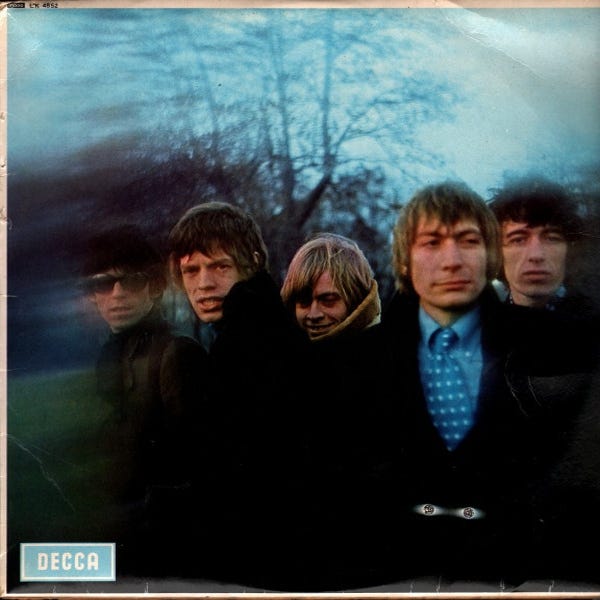
Tracks: 1) Yesterday’s Papers; 2) My Obsession; 3) Back Street Girl; 4) Connection; 5) She Smiled Sweetly; 6) Cool Calm And Collected; 7) All Sold Out; 8) Please Go Home; 9) Who’s Been Sleeping Here; 10) Complicated; 11) Miss Amanda Jones; 12) Something Happened To Me Yesterday.
REVIEW
1967 has not exactly gone down in the Stones’ own memory as their finest year. For them personally, it was the year when The System finally began to take its revenge on the rebellious young man — who breaks a butterfly upon a wheel? and all that — and although very little of that year was actually spent by Mick and Keith behind prison bars (one night, to be precise), much of it was spent realizing that a life of sex-and-drugs-and-rock-and-roll was not going to be a permanent rose garden. Touring, just as it was for the Beatles, became exhausting — and, in fact, although the Stones themselves never took any vows to refrain from performing live (neither Mick nor Keith would ever subscribe to such an attitude voluntarily), it is not exactly a coincidence that in between April 1967 and November 1969, the band only appeared on occasional TV shows and at special one-time events. The main reason for this is usually quoted as the ongoing decline of Brian Jones’ mental and physical health — but in reality, they were all exhausted from the brutal schedules, the technical difficulties, and the unruly audiences. The old ways of putting on a rock’n’roll show were going, and the new ones had not yet properly emerged, and 1967–68 in general was very much a «sit-it-out-in-the-studio» kind of period.
Yet on the other hand, if there ever was a band less suited to sitting it out in the studio, it was the Rolling Stones. More than for anybody else in the UK pop business, their natural habitat had been the stage — as good as their studio recordings were, they could hardly wait to take them outside and give them a new, dynamic life before live audiences. Experimenting with new studio technologies was neither Mick’s nor Keith’s forte; only Brian accepted the studio-based life as a fascinating challenge to expand his instrumental palette, and even that fascination lasted for only about a year before his volatile nature and drug intake quickly melted his own emerging artistry into a puddle. Rhythm, movement, energy, aggression — all these things, so vital to the Stones’ nature, were much harder to generate in a closed environment.
On top of that, 1967 was the year when British pop music was quickly beginning to overcome its obsessive infatuation with all things American, and to reclaim some of its own European legacy, as well as turn its attention to the East rather than the West — the year in which, one might say, J. S. Bach and Ravi Shankar were becoming no less idolized than Muddy Waters or Chuck Berry. Of course, we are not going to subscribe to the prominent myth that the Stones’ understanding of music was always limited to the paradigms of Delta blues and Chicago-style rock’n’roll; Western classical influences and an air of traditional Britishness were prominent in the band’s music as early as 1965, from ‘As Tears Go By’ to ‘Play With Fire’ — and steadily kept on growing throughout 1966, with or without Brian Jones’ involvement. But nor would it be wise to insist that kaftans, sitars, lutes, and 18th century fugues would come perfectly naturally to the Rolling Stones. In 1967, this stuff was coming to pretty much everybody as a form of peer pressure — adapt or perish — and, as such, 1967 got stuck in Mick and Keith’s mind as that one year during which, for various reasons, from political to artistic, had put their musical future under perhaps the most serious threat of their entire lifetime.
There are, therefore, certain understandable objective reasons why both of the original LPs they put out in 1967 might be labeled as «not genuine Rolling Stones albums». As we know, neither Mick nor Keith have ever held high opinions of either Between The Buttons or Their Satanic Majesties’ Request — and although independent critical assessment of the former has traditionally been rather positive than negative, the latter still remains extremely divisive for fans and critics alike. Very little material from both of these records has ever managed to make it into the band’s live set, and a common word of mainstream critical advice for a long, long time was that everybody should really start their Stones’ journey with Beggars’ Banquet, because this is where the true Stones finally emerge in all their decadent glory — a mass-held opinion which I remember discovering with a big surprise back in the early days of the Internet, having lived through my isolated late-Soviet teenage years happily listening to both Buttons and Satanic as simply two more of those awesome Stones albums, without knowing that I was actually supposed to downplay them in my mind for not representing the authentic spirit of the Rolling Stones’ music. (Nor, for that matter, did I have the faintest idea that I was supposed to hate Bob Dylan’s Self-Portrait, The Doors’ The Soft Parade, or just about every solo Beatles album ever released with the exception of John Lennon/Plastic Ono Band, All Things Must Pass, and Band On The Run. Ignorance is bliss, right?).
The thing is, we shall probably never know the real truth about those songwriting and recording sessions stretching from late 1966 to mid-1967 — how much of them was fun, how much was natural, and how much was «oh God, I hate to do this shit but that’s what kids seem to want these days, so let’s get to it». All we really have is our own feelings and thoughts, and in evaluating art, those matter just as much as — sometimes more than, in fact — the original intentions and moods of the artists. In retrospect, Mick Jagger is free to look back at Between The Buttons and evaluate it as «a pile of rubbish» — exactly the same way as some random dude who rates this as a 1-star record on RateYourMusic, and with about the same level of credentials. But the fact of the matter is that by 1966, Mick and Keith had matured as expert, creative, intelligent, meaningful songwriters, and even when they found themselves writing in styles they’d never tried before, the talent and the sincerity of the drive could not be simply locked up and forgotten. So much about the music-making in that era involved pushing oneself out of one’s comfort zone, anyway, that reducing the Rolling Stones circa 1967 to the status of «reluctant copycats» is more or less equivalent to not getting what the spirit of 1967 was all about in the first place.
That said, Between The Buttons actually came out in January 1967 — way before Sgt. Pepper and even before ‘Strawberry Fields Forever’ — and most of the album was recorded in the fall of 1966, so it should really be paired up with Aftermath rather than Satanic in terms of stylistic coherence. Although there is certainly a bit of psychedelic flavor present in the recordings, the prevailing vibe is still a well-grounded «Britishness» rather than anything «cosmic», as the Kinks continue to be one of the Stones’ main influences for the LP, which, by the way, was even recorded almost entirely in London this time, as opposed to the band’s predilection for the American Chess and RCA studios in past years. Thus, what we have here is the Stones’ «London sound» at the height of its development, for better (says me) or for worse (says Mick Jagger, but who gives a damn about Mick Jagger anyway?).
As usual, there would be differences between the UK and US versions of the album: for the latter, two LP tracks (‘Back Street Girl’ and ‘Please Go Home’) were removed to make way for the band’s latest hot single, the double A-side of ‘Let’s Spend The Night Together’ and ‘Ruby Tuesday’. The removed LP tracks would end up on the US-only Flowers later in the year, but, surprisingly, so would the single as well — up to that point, US Decca at least tried to avoid direct overlap in their handling of the Stones’ «inflated» US catalog, but Flowers ended up breaching that unspoken agreement. In any case, I will concentrate on the original UK edition here, holding off analysis of ‘Let’s Spend The Night Together’ and ‘Ruby Tuesday’ until we get to to Flowers — I don’t really think either of the songs vibes too well with the generally cohesive material of Between The Buttons, as by that time the Stones were beginning to think more and more in «LP terms» and the mangling of original running orders on US editions becomes much more of a problem in 1966–1967 than it used to be in 1964–1965.
Notably, the proper UK album was neither based on any central single nor yielded any such singles in retrospect. Even more strikingly, Between The Buttons is a record that has no clear highlights or lowlights — Mick’s future disdain for the album has prevented any of the songs from becoming live «warhorses», but even without that detail, every time I look at the track listing I find myself at a loss: all the songs are cool, one way or another, yet not one clearly stands ten feet high over everything else. Instead, Between The Buttons is sort of an unintentionally conceptual record, following in the footsteps of ‘Play With Fire’, ‘Stupid Girl’, ‘Have You Seen Your Mother, Baby’, and other Stones songs focusing on Mick Jagger’s girl issues — the only difference being now that every single song on the album, except for the very last one, is focusing on those issues. It’s certainly not that big a surprise, as the end of 1966 found Mick transitioning from his old flame — Chrissie Shrimpton — to his new one — Marianne Faithfull, and an obsessively literal mind could easily sort out the material, putting the moody / angry / pissed-off tracks in one neat little pile («those are Chrissie’s») and the admiring / romantic / empathetic ones in the other («these go to Marianne»). A less literal mind would remember that there may be other girls, too, both in the real world and in the imaginary one — also, one should remember that the Stones’ songwriting was never limited to Mick, as some of these songs (‘Connection’, for instance) are almost 100% Keith.
But the main point stands. As much as the Stones could have really been influenced by the Kinks at that moment, the chief nature of that influence would have to be described as a silent call to «observe what goes on around you and sing about the stuff that really bothers you». Ray Davies, a quiet and introverted observer with not a whole lot of personal social connections, exercised that principle by making astute sideways observations on various sides of English society. Mick Jagger, the definitive social buzzfly in the Swinging London years, preferred to focus on his own interactions — usually with the ladies — and, fortunately, for all his misgivings as a human being, was at least blessed with a pretty sharp intellect to make his descriptions of those interactions interesting, as well as with plenty of talented musical friends to reinforce those impressions with memorable melodies and cool textures.
Thus, even from a sociological point of view Between The Buttons is just as representative a slice of British high-middle-class society in the mid-Sixties as the Kinks’ albums such as Face To Face and Something Else — at least, it breathes the same spirit, even if Ray and Mick frequent different areas of London Town to sniff it. Not coincidentally, there is even some common musical glue between the two, as the album marks the first documented cooperation between the Stones and Nicky Hopkins; having just completed his piano sessions for Face To Face, Nicky was introduced to the Stones just in time to put his touch on ‘Cool, Calm & Collected’ — just one track for now, but one that marks the start of perhaps the most important and efficient collaborative relationship in Nicky’s generally impressive curriculum.
Turning now properly to the songs, it would make sense to discuss them not in their exact running order, but to divide the bulk of them in two slightly unequal parts which, to please the literally-minded fans, I shall be calling «The Chrissie Side» and «The Marianne Side» respectively — one focusing on the negatives, the other mainly embracing the positives. Needless to say, the dichotomy is rarely 100% precise: some of the songs have a mixed flavor, where it is difficult to guess whether sarcasm is more prevalent than genuine admiration, or even if the narrator himself is coming or going. But we’ll still try to wing it somehow, because... it’s kinda fun, and we do have to emphasize the oft-overlooked fact that not only is Between The Buttons the quintessential «British» album for the Rolling Stones, it’s also, in a way, their quintessential «How To Make A Taylor Swift Album That Does Not Suck» project, if we look back at it from a 21st century perspective.
The «Chrissie side», then, starts off with ‘Yesterday’s Papers’, a cursory glance at the lyrics of which would surely be enough to turn it into one of the modern world’s most despised holdovers of the Stones’ legacy. “Who wants yesterday’s papers? who wants yesterday’s girl?“ “Yesterday’s papers are such bad news.” And, of course, the unforgettable: “Seems very hard to have just one girl / When there’s a million in the world.” I mean, next to this stuff the shunned-and-ostracized ‘Brown Sugar’ is perfectly innocent — you can call that one tasteless if you’re overtly sensitive, but at least it worships (black) women in its own odd way, while ‘Yesterday’s Papers’, based on these quotations, is the anthem of a modern-day Don Giovanni who views women as disposable conquests for one day, thrown out like used condoms once you’re done with them. Bad, bad Mick Jagger.
Anybody who’s interested in a little something more than self-righteous virtue, though, will find plenty of far more curious and sophisticated details about the song. First of all, the mood of the song is anything but Mick Jagger’s equivalent of Don Giovanni’s Champagne aria: it’s a tragic number, closer in attitude not to ‘Under My Thumb’, with which it is often compared, but rather to ‘Paint It Black’, lamenting the end of a relationship. Second, all the quoted lyrics have to be taken in their context. “After this time, I finally learned, after the pain and hurt...“ — clearly, the protagonist feels used and deceived himself. “All of these people just can’t wait / To fall right into their big mistake“ — the idea is that he’d like to swear off relationships and commitments forever, but has no strength of will for that. Clearly, ‘Yesterday’s Papers’ is little more than a frustrated, hyper-ventilated rant against your ex that many of us allow themselves to keep our sanity after a painful breakup — and delivered by Mick in a broken-hearted, vulnerable tone at that, even more vulnerable, in fact, than on ‘Paint It Black’ itself. By the end of the song, you should be feeling pity, not disgust, for its protagonist (as opposed to real-life Mick Jagger, of course, whose actual breakup with Shrimpton was nowhere near as romantic).
Additionally, ‘Yesterday’s Papers’ is a little bit of a musical masterpiece, isn’t it? At its core, it’s got the feeling of a slightly sped-up Motown number — Smokey Robinson may have been an influence — but on top of that, it wears so many different coats that it quickly becomes a two-minute extravaganza of kaleidoscopic psychedelia. Charlie’s jungle-like tom-toms and Bill’s grumbly bass. Jack Nitzsche’s baroque harpsichord. Brian’s sweet little vibraphone arpeggios in the lead. The ghost-like backing vocals. Keith’s minimalistic, but hardcore fuzzy lead guitar break in the middle. No other Stones album to that point would open with such an amount of beautiful sonic layers — in sheer production terms, ‘Yesterday’s Papers’ can quite proudly compete with the best of what the Beatles and the Beach Boys, let alone lesser challengers, could offer the world out of the comfort of their rigged-for-1966 recording studios. Had this simply been a stupid misogynistic piece of braggadoccio, would they really have to pull out all those stops in such a symphonic manner? It’s like a flurry of different emotions, pulling you in all directions at the same time; easily one of the band’s Top 10 creative arrangements.
The drama continues with the opening track on Side B, where, instead of addressing us listeners directly, Mick turns his gaze back on his estranged lover with a barrage of straightforward accusations on ‘All Sold Out’: “I hope that you’re having fun with me / There’s not much left to attack“. This time around, the lyrics are somewhat obtuse, and if it’s really his breakup that he’s obsessing over again, it is not particularly clear in which way his girl really “sold him out” — anyway, what matters is that this time around the tone is dark, brooding, and almost vengeful. Keith overdubs two guitar parts for this mid-tempo pop-rocker: the rhythm is sludgy and brutal, while the lead is «poisonous» and sarcastic. Even so, Brian still tries to put his own touch on the thing by slipping in a mildly haunting recorder part in the bridge section — you can barely hear it buried deep below the guitars, but it still succeeds in mollifying the crackling-dry atmosphere a little. Hardly my favorite Stones song, but it is catchy like everything else on here, and I’ve also always loved the way it starts, with those two seconds of Charlie’s loud drum intro fading in out of nowhere and then, wham, straight to business.
The accusations then continue to fly on ‘Please Go Home’ — a track, I remember, that used to drive a very young me bonkers on the otherwise clean and melodic sound of Flowers when «heavy» and «noisy» did not yet click with my inexperienced little brain. At its core, the song is nothing but a simple rehash of the Bo Diddley groove, as if the Stones were returning to their own roots, all the way back to 1964 when they were sending ‘Not Fade Away’ to the UK Top 10. But on the surface, this particular groove has swollen into a lumbering monster on psychedelic steroids: the riffs are thick, distorted, and fuzzy, there’s feedback seeping all over the place, Charlie’s tom-toms and crashing gongs add monumentality, and on top of that, Brian arrives to the studio with a theremin — must have been listening to the recently released ‘Good Vibrations’ all through the night before.
The result is the thickest, messiest, most chaotic jumble of sound the Stones had been able to concoct in the studio so far, almost as trippy as anything you’d hear from the Beatles at the time but, somehow, never losing track of the groove — whatever happens, Charlie and Bill are steady as a rock, sending those get-up-and-dance impulses to your brain like their life depended on it. Whether it was the right kind of groove and atmosphere to combine with lyrics like “I won’t be the first or the last / In the sea of the thousand you cast“ is another matter: perhaps the idea is to conjure a symbolic atmosphere of a very, very messy and annoying social event where our lyrical hero finally convinces himself that his vampiric girlfriend is ultimately the chief source of annoyance (”It’s madness to look and to find / Your false affections so kind“). Personally, I would think that this kind of music would be better suited to words like those of Creedence’s ‘Commotion’ (”rushin’ to the treadmill, rushin’ to get home“), but I guess you can still make it work. A fine effort anyway — and a clear precursor to the psychedelic rhythm’n’blues sound they’d soon be elaborating on Satanic Majesties.
Right after the titanic thunderstorm of ‘Please Go Home’ comes the relative calm and agitated pensiveness of ‘Who’s Been Sleeping Here?’, a song whose title usually brings up thoughts of jealousy and adultery: “The butler, the baker, the laughing cavalier will tell me now who’s been sleeping here...“. I’m not even sure that that’s the case — when you add up all the words together, they do not quite add to a musical portrait of a flustered lover who’s just been «cucked» by approximately half of the town’s population. (Otherwise, we’d have to add accusations of incest to the pot after lines like “was it your mummy, your daddy, who’s been sleeping here“). What is perfectly clear is that Mick chooses the Goldilocks and The Three Bears story for his main frame of reference — and that his narration, with lots of randomly interweaving characters (”the sergeants, the soldiers, the cruel old grenadiers“ etc.), makes it clear that he desperately wants to write a classic Dylan song, so one certainly shouldn’t strive here for a too literal interpretation.
At the risk of overthinking it (would this count as bad karma, I wonder?), I’d say that the subject matter of ‘Who’s Been Sleeping Here?’ is not so much jealousy or infidelity as breach of privacy — and from that point of view, it does not stray too far away from ‘Please Go Home’: both songs find their protagonist grasping for freedom from the clutches of somebody whose lifestyle and values feel like a cumbersome imposition. The question of who’s been sleeping here? should not be understood as who’s been sleeping with you? but rather as who’s that you brought over to sleep in MY bed? get ’em out of MY house! — something that, in real life, may have had something to do, for instance, with Mick feeling dissatisfied over Shrimpton’s own circles of friends, though this is but a mere suggestion.
In any case, one thing everybody will probably want to agree on is that ‘Who’s Been Sleeping Here?’ tries to be a psychologically complex performance, playing off Bob’s «mood-switching» songs of the Blonde On Blonde era — such as ‘Just Like A Woman’ or ‘One Of Us Must Know’, what with each verse divided into a «plaintive» and «hysterical» part, so that the first one is largely controlled by Keith’s strumming and the second by Jack Nitzsche’s triumphant, almost polonaise-like piano thumping. I absolutely love that transition when the full band kicks in — the piano, aligning itself well with the ballsy uplift in Jagger’s voice, heralds a smooth shift from submission to dominance, with each verse starting off like a pitiful whine and then going into full-on personal rebellion mode, emphasized even further during the instrumental break, when the song becomes even darker and Keith breaks out an aggressive, screechy electric guitar break (pay attention and you’ll see that for just a few bars in the middle, the song pretty much becomes a preview of ‘Midnight Rambler’!).
By the time of the final fade-out, we’re almost in psychotic territory — it’s probably a good thing to have it fizzle out before we actually have to watch Papa Bear rip the stuffing out of poor Goldilocks. Like it or not, though, it’s a pretty unique type of spectacle for the Rolling Stones, and, arguably, Jagger’s single finest regurgitation of the Dylan influence: while next year’s ‘Jigsaw Puzzle’ would be an even more transparent homage, it would also be a bit more flat-footed, with less acute dramatic peaks and, frankly speaking, less psychological depth (though compensated with a far more polished sound).
The last song belonging to the imaginary «Chrissie side» (though, allegedly, it is more of a composite portrayal of one of those socialite types that Mick so loves to deride) is ‘Miss Amanda Jones’, probably the closest thing this album has to a fast and dirty garage-rocker but still «spoiled» by the Stones’ newly discovered penchant for random overdubs (multiple guitar layers, Hammond organ, I think there’s a harpsichord tinkling somewhere down there too but might be a tampered-with electric piano or something). The idea here was to create a musical «whirlwind» (”round and round she goes“), symbolic of the young protagonist’s mad rush through the dubious joys of life, and I love to see Keith getting into it — watch those opening three seconds of his distorted riffage as the guitar gives the impression of trying to find its purpose in life, then, on the fourth second, settles into a proper rhythmic groove with a faster tempo and signals the rest of the band to kick in as «Miss Amanda Jones» joins the ranks of the discotheque crowd without looking back (nevertheless, “of her lineage she’s rightfully proud“ because, like all aristocratic ladies going out there, she does like to have her cake and eat it too).
It is precisely when I listen to this kind of heavily underrated rocker and then contrast it with the «generic rock» of the Stones’ later days (think something like ‘Dance Little Sister’, for instance) when the magic effect of 1967 manifests itself the clearest — for all the messiness of the sound, songs like ‘Miss Amanda Jones’ combine complexity, intelligence, and kick-ass rock’n’roll drive in a way that would never again be seen in popular music after the ideology of «distorted guitar-based riff-heavy rock» took over. There are ways in which a song like ‘Dance Little Sister’ would be superior — its deliciously dirty riffage opens up before you in full naked glory — but the problem of the cheap thrill is not in that it is necessarily «inferior» to the sophisticated thrill, rather in that it leaves little incentive to return back to the sophisticated one. At this point in their career, the Stones were capable of dazzling coatings for their basic rock’n’roll instincts; later on, they would discard them in favor of the proverbial «rawness» and «authenticity», only to see those quickly degrade into «predictability» and «formulaic boredom». ‘Miss Amanda Jones’, on the other hand, is a song where the riffs, the additional overdubs, the lyrics are well worth returning to and mulling over time and time again.
Anyway, there goes the prosecution: ‘Yesterday’s Papers’, ‘All Sold Out’, ‘Please Go Home’, ‘Who’s Been Sleeping Here?’ and the slightly less personal, but even more sarcastic ‘Miss Amanda Jones’ all make a strong collective argument that them women are nothing but trouble — in subtler and more intelligent terms, I might add, than the traditional «bitch cheated on me with my best friend» blues idiom. But the Stones wouldn’t be the Stones, and particularly Mick Jagger wouldn’t really be Mick, if they did not bother to outbalance the negative with the positive; so let us proceed to the alleged «Marianne side» to see how, at this point, the band fared with brighter vibes.
In all fairness, only ‘Complicated’ can be said to have been directly written about Faithfull: “We talk together and discuss / What is really best for us / She’s sophisticated / My head’s fit to bust / Cause she’s so complicated“ confirms this in no uncertain terms — probably written right after Marianne set him up with another of Bulgakov’s novels or something. Few people ever pay much attention to the song, but, like almost everything on the album, it’s a fairly bizarre creation that rewards deep scrutiny. The melody is kind of a music-hall / blues hybrid, giving you avery mixed vibe. The arrangement is just as sophisticated as its protagonist, with Keith throwing on fuzz riffs, Brian puncturing the song with tiny recorder puffs that are barely heard, but acutely felt in the mix, and perhaps the biggest musical star is Charlie, whose syncopated pattern sets the opening groove — he is almost on the brink of getting a couple drum solos to himself, in fact, the instrumental breaks in the song are all about the drums, which is a phenomenal rarity in the Stones’ catalog.
And all of this weirdness is not just for weirdness’ sake: ‘Complicated’ does a pretty good job of conveying a mixed sense of admiration, confusion, and sadness — a perfectly assorted bunch of emotions that your average LSE dropout might experience while dating a far more refined and far-seeing partner than himself. We know all about Mick’s misgivings in his relations with women, but at least he never underestimated them, and ‘Complicated’ feels like a guy at the crossroads, scramble-brained and unsure of whether this particular romance will eventually lead to happiness or insanity. The song never gives a definite answer — instead, it just gains further in turbulence over the fade-out coda, with Charlie’s incessant thumping and Keith’s fuzz symbolically conveying poor alpha-male’s brain struggle. Oh well, that’s what you get for hooking up with somebody above your average paygrade level, I guess.
Much less certainty exists about ‘Cool, Calm & Collected’, which closes Side A of the album. Some of its imagery may also have been inspired by Marianne, but overall it’s more of a composite portrait of another imaginary socialite — in fact, if Miss Amanda Jones is the daughter, the protagonist of this one could very well have been her mother (or, at least, elder and more experienced sister). Musically, with Nicky Hopkins leading the way on ragtime piano and Brian throwing in an almost hysterical kazoo solo, this is as close to classic music hall as the Stones ever got — again, allegedly influenced by the Kinks, but far more vaudevillian in nature than anything Ray Davies had produced up to that point; in fact, this kind of merry-go-round sound would be far more popular with Ray in his early 1970s era of increased theatricality than it was in 1966–1967. On here, the Stones deliberately turn into clowns for four minutes — I can almost imagine them in paper hats and with red noses in the studio while blowing away. Kind of appropriate, too: Mick Jagger as the mocking court jester, putting on a show for the haughty lady of the house.
Although the tune itself is fairly slight, simple, and whimsical, it does gain a bit of menace at the end — the idea to speed up the final instrumental section was pretty spontaneous, according to Mick’s own reminiscences, but as the tempo goes up and up and up, with guitars and harmonicas and bass gaining in volume over Nicky’s piano, there’s a faint shadow of darkness rising up over the merriment (again, a bit of that jamming brings on a slight foreshadowing of ‘Midnight Rambler’ two years later), and the way the song ultimately crashes and burns is... well, decidedly not funny, as if the evil clowns accidentally lost control over themselves and ended up self-exploding. If, once more, we allow ourselves the luxury of overthinking, the coda could be seen as a warning — put too much pretentious strain on yourself (”in public the strain’s hard to bear / she exudes such a confident air“) and eventually you’ll be bursting from too much pressure. See, we just transformed a throwaway comic number into a gruesome 18th century morality play. All you socially active well-to-do ladies (and gentlemen, for that matter) take care now!
The question is: is Mick Jagger actually capable of coming up with a song that projects an unabashedly, unashamedly positive vibe in the direction of his currently selected personal angel? Up until now, we have not yet seen anything from the Stones — not a single original track, in fact — that would just say «I love you — no strings attached». Because everywhere you looked, there were always some strings attached, and at a certain point, this almost gets irritating — what could, at first, pass for artistic sophistication and refusal to fall into the trap of dusty old romantic clichés, eventually congeals as bratty teenage contrarianism and persistent immaturity. You don’t have to consistently churn out corny, insincere love ballads, but unless you have a valid excuse because you’re AC/DC, sooner or later somebody has to break your heart of stone or the insincerity is coming back at ya anyway.
From this point of view, ‘She Smiled Sweetly’ could be one of the most fascinating songs the «bad boys of rock’n’roll» ever did. Music-wise, I have no idea where it comes from; the rhythm and basic chord sequence seem to have a folk provenance, mildly reminiscent of Dylan’s early acoustic stuff or the Byrds, perhaps. But the main theme is played on the organ — by Keith Richards himself, no less, and, in fact, it’s a fairly intimate recording that only features Mick, Keith, and Charlie (possibly with Jack Nitzsche on extra piano, although Keith went on record saying that’s him on the piano overdubs as well). This gives the piece a bit of church solemnity — at the beginning, it’s like you’re stepping into a wedding ceremony or some other ritual — and agrees perfectly well with Mick’s exquisitely beautiful vocal performance, closely hugging the mike with a little dreaminess, a little nervousness, and quite a bit of tenderness. (Amusingly, tons of clueless YouTubers drop comments like “thank you Brian for your beautiful organ part!“ because they cannot even conceive the idea of Keith being able to play anything other than his crude ’n’ dirty open G riffs).
And the song is not a simple love declaration: in less than three minutes, it’s a gentle and perfectly summed-up reminder of one of the biggest reasons relationships are a thing in the first place — to help people preserve their mental sanity. Whether the dialog exchange, presented in the song, is reflective of any of Mick’s real-life interactions with his past or present girlfriends is irrelevant: what matters is the believability of the picture — he is gripped by anxiety and paranoia (”Why do my thoughts loom so large on me?“), she is lovingly and wisely providing the much-needed stability anchor (”there’s no use trying, you’re here, begin again“ — for some reason, most lyric sources on the Web give this as begging again which makes no sense whatsoever), and he gets his much needed psychic healing (”I understood for once in my life“). This way, ‘She Smiled Sweetly’ is a hundred times better advertisement of traditional family values than any cereal commercial ever filmed — even if Mick and Keith might not exactly envisioned it that way at the time. (Amusingly, I think it’s far more applicable to Keith and Patti Hansen in the end than Mick and any of his transient muses).
It’s songs like this one which really expose all those grumbling «Stones can’t do pop music, it’s not them!» characters for the pathetic small-minded bigots they are: ‘She Smiled Sweetly’ is a perfect pop song, as expertly composed and haunting as any Zombies number, with not a single misplaced note or poor arrangement decision. Keith’s simple, but thick and insistent bass walks hand-in-hand with Charlie’s big, but slow drum pounding — and the decision to «lend» the bridge section to the calming presence of Mick’s unseen muse, turning the song into a real dialog, is quite theatrical as well. It’s really one of those songs that requires time to grow on you — with each passing year of your life, it only becomes more and more relevant, and it is hardly a coincidence that Lindsey Buckingham himself, relatively fresh from already covering ‘I Am Waiting’ five years earlier, chose ‘She Smiled Sweetly’ as his follow-up Stones cover at the tender age of 62. In my book, this ranks up there with Lennon’s ‘Woman’ as one of the finest examples of «male worship of the female presence» ever recorded in the annals of pop music.
Consequently, it is ironic as heck that it is separated by only one track from ‘Backstreet Girl’, which is, conversely, the single most lyrically cruel artistic piece Mick had the nerve to craft in his entire life. The melody and arrangement are absolutely gorgeous — in atmospheric terms, they take after ‘Lady Jane’, with the vibraphone and accordeon replacing the dulcimer as the toppings of choice, but the effect is more of a mix between the Appalachian and the Parisien, what with the gentle acoustic waltzing and the street-corner accordeon joining in harmony. As it did already happen with the mischievous lyrics to ‘Lady Jane’, many an unattentive or a non-English-speaking listener may have been lulled into thinking he’s listening to a tender love serenade — and, honestly, I don’t think any real-life character ever delivered the lines “Please don’t you bother my wife / That way you won’t get no hell“ to his undercover mistress in such a sweet, delicate, caring, sensitive tone as Mick brews up on this particular studio session.
It’s pure theater, of course, just like ‘Lady Jane’ — I’m sure Mick must have had himself plenty of «backstreet girls» in his Bianca or Jerry Hall years, but back in 1966, whatever infidelities he practiced must have been fairly well in the open (and fairly random as well); disturbingly, though, he really gets into character, and the only perceivable irony is in the hundred different ways in which he strives to make his lyrical character so nasty and unappealing to his audiences. In other words, it’s such an exaggeratedly caricaturesque depiction of infidelity and misogyny that it’s hard to picture it as anything other than a «dirty fantasy» (perhaps secretly entertained by quite a few of us in our mischievous time o’ day — except that we usually keep such fantasies to ourselves, locked away in safely guarded cells of our brain, rather than let them loose in our artistic output or, God forbid, in real life).
Whatever be our emotions and judgements, though, it is difficult to forget the jaw-dropping contrast between the elegant music, which is the very antithesis of “common and coarse“, and the exquisitely condescending lyrics — or the sweetest, tenderest way in which, almost bordering on purry-whispery, Mick croons “just you be my backstreet girrrrrrrl...“ at the end of the song. Had this been a sexually charged rocker — ‘Backstreet Bitch’ rather than ‘Backstreet Girl’ — it would have sounded sleazy and stupid (though possibly also seductive); sounding as it is, though — a gorgeous under-the-balcony romantic serenade — it digs much deeper into the issue of romantic attraction vs. class distinction. Buried in between two loud pop-rockers, it is so quiet that one might even fail to notice it properly at the beginning... once noticed, though, it’s a song that is downright impossible to forget in all of its internal contradictions. (Also, the presence of the accordeon inevitably brings up the idea of ‘Backstreet Girl’ being the Stones’ answer to ‘Michelle’ — come to think of it, wouldn’t the «Michelle» in question, unable to understand a single word from the suave English gentleman, count as Paul McCartney’s own «backstreet girl», in a manner of speaking?).
If the darkness of ‘Backstreet Girl’ only emerges with the lyrics, then ‘My Obsession’ — allegedly known as Brian Wilson’s favorite Stones song, as he was present at the RCA Studios when the Stones were recording it — is dark all the way through, riding on a wave of deep, fuzzy bass and guitar melodies that establish quite a unique grumbly hum background, against which Ian Stewart is laying down line after line of blues-boogie piano soloing that somehow also take on a sinister air. The song is probably notable for Charlie’s kick-TSHH-kick-TSH-TSHH pattern more than anything else — I can’t «decode» any particular meaning in it, but, uh, it sure is quite an obsessive rhythm, which may just do the trick. Meanwhile, Mick continues to ape Dylan’s love for trisyllabic Latin borrowings — obsession, posession, confession, objection, profession, impression, discretion, direction — which certainly muddies up any meaning the song might have, but whatever that meaning might be, one thing’s for certain: it’s not a very, uh, comfortable one.
Well, there are some key lines in here, aren’t there? “I want it just to be mine, exclusively“. “There are things in this world that need teaching with discretion“. “Do you feel at home right here?“ “Didn’t see you were so young“ (though this one is immediately followed by the oxymoronic “I could almost be your son“). If somebody wanted to make a case for this song as the local anthem of Little Saint James, it wouldn’t be that hard to do — although I certainly hope that Mick’s inspirations and fantasies didn’t stretch out that deep into the abyss. Even so, there’s definitely a little satanic flair going on here; I wouldn’t have been surprised if this track ended up on the soundtrack of Performance, or found itself at the center of whatever other provocative and borderline-psychopathic experience Mick might dabble in at the tail end of the Sixties, before the reality of Altamont jerked him out of it and returned him to the glitzy sanity of show-biz.
Compared to ‘My Obsession’, the other -tion song on here, ‘Connection’, is almost like a Herman’s Hermits number in comparison. Mostly a Keith creation (he would even occasionally choose it as one of his live solo spots on late-period Stones tours, as well as do it at his solo shows), it’s a fun pop-rocker about yearning to reconnect with his special one after all the troubles on the road (”my bags they get a very close inspection, I wonder what it is that they suspect on“ — ask Detective Sergeant Pilcher, Keith!) with a beautiful expression of longing in the chorus: “all I want to do-o-o-o-o... is to get back to yo-o-o-o-u...“ — one of those eventually-to-become trademark soulful howls that Keith does so well instead of, you know, conventional singing.
Keith does not, however, get a solo lead on this song — as opposed to the closing number, ‘Something Happened To Me Yesterday’, where, for the first time in Stones’ history, he swipes the lead mike away from Jagger for the chorus. Believe it or not, I know people who hate the song because it’s, you know, vaudeville. Carnival brass, stupid tempo, cabaret atmosphere, total disgrace and catastrophe. Lighten up, people! Yes, the Stones had a little fling with the circus genre in the Swingin’ London years — culminating, of course, in the Rock’n’Roll Circus — as did the Beatles with their own Magical Mystery Tour, as did The Who with ‘Cobwebs And Strange’, as did The Doors with their album sleeve for Strange Days, as did pretty much everybody in those odd times. Is the song catchy? It sure is. Does it make sense? It absolutely does. Has it what it takes to serve as the closing number? That’s precisely why it is there in the first place. No more questions, your Honor.
He’s not sure just what it was, or if it’s against the law. This actually brings us to the most important question ever: is Between The Buttons, on the whole, a «trippy» album? For Satanic Majesties, the answer would be obvious. But at the tail end of 1966, weed and LSD were not yet at the absolute center of most artists’ creative processes — even Revolver had its trippy moments, but could hardly be called a quintessentially psychedelic record from top to bottom. Certainly songs like ‘Please Go Home’ and ‘My Obsession’ have their sonic shades of mind-confusion, yet there’s a difference between pure studio experimentation and an intentional desire to fuck with your listeners’ minds, and I’m not sure that merely having Brian Jones drag in a theremin for the ‘Please Go Home’ session already qualifies as the latter. Gered Mankowitz’s photo for the album cover, with a Vaseline filter responsible for making Keith and Bill look like they’re about to dissolve into thin air, certainly does qualify as psychedelic, but Gered Mankowitz did not exactly write or record the album’s music — and by now we must have all seen that Mick and Keith’s main preoccupation here was to show us, through lyrical and musical means, how different women (or maybe even the exact same women) can be demons and angels: a goal that has rarely been achieved in the history of mankind by consuming mass quantities of lysergic acid diethylamide. (Apparently if you do try it that way, all women just turn into Lucies in the sky with diamonds, regardless of their inborn natural states).
Even ‘Something Happened To Me Yesterday’ itself is hardly a «trippy» song. One might discard it as silly fluff, but one might also think of it this way — in 1966, the Beatles did progressive-sounding songs about drugs, and the Kinks did old-fashioned songs with a music hall flair... but was there anybody except the Stones who thought of doing an old-fashioned song with a music hall flair about drugs? There’s this classic not-give-a-damn British attitude on parade here combined with a risky theme — humor, danger, and refinement all in one — and with the addition of the circus atmosphere, you could also say ‘Something Happened To Me Yesterday’ is doing Sgt. Pepper here, on an admittedly small scale, before there ever was a Sgt. Pepper. In fact, Mick’s ad-libbed ending — “thank you very much and now I think it’s time for us all to go, so from all of us to all of you, not forgetting the boys in the band and our producer, Reg Thorpe, we’d like to say God Bless“ — stylized a bit in the manner of some old BBC radio programme goodbye, is just a step away from “we hope you have enjoyed the show, we’re sorry but it’s time to go“; they even invent their own producer (no “Reg Thorpe” ever shows up in historical annals) as their own Sgt. Pepper.
Thus ends this odd, unjustly overlooked little masterpiece in the Stones’ catalog, which, like any truly great album, only seems to grow more and more intriguing with each new listen. To all those who continue to insist that «this is not the real Rolling Stones» I can only point out that in early 1967, nothing was «real» (and nothing was to get hung about). Like everybody else, the Stones were evolving, trying to point their talents in new directions, yet even one serious listen to Between The Buttons is enough to show that they were hardly betraying their core values and attitudes. On the contrary, by busying themselves with more sophisticated musical arrangements and less transparent lyrical imagery, they were adding far more depth and color to those values than ever before. Yes, some of these songs may be melodically more repetitive or lyrically a bit clumsier than others, but every single tune on here makes a valid point or two — not one could be described as a last-minute filler (which is still a bit of a problem with Aftermath).
Apparently, some people find serious problems with the original mix of the record, blaming everybody from the Stones themselves to Andrew Oldham to RCA engineer David Hassinger for not finding the right ways to properly blend in all of that extra instrumentation. Poor production was even acknowledged in retrospect by Mick and Keith themselves — one more reason why they don’t share fond memories of the record. I can, perhaps, vaguely understand what they’re all talking about, but I, for one, have never had any problems with this mix. Exile On Main Street — now that’s another matter, because you can barely even hear Mick singing there on some of the tracks. But Between The Buttons, even when Keith’s guitar riffage ends up having its face sat upon by Brian’s theremin or something, still sounds right to me: no, it’s not the sound of an in-yer-face hard rock band, it’s the sound of an artistic group of people using their hard rock experience to work out new types of sound. If some instruments stick out less than others at first... well, just go ahead and listen to the record again. And again. Each time, it brings out something new, some musical idea you weren’t so well aware of at first.
As for the argument that the Stones are ripping off others a little too much — ripping off the Kinks, ripping off Dylan, ripping off the Beatles, etc. — I can only say this: at the heart of almost each and every one of those songs is Keith Richards, and Keith Richards is not ripping off anyone. By late 1966, our guy had developed his own style of playing and composing, and nobody in the music business had his kind of approach to guitar playing. This was the early period in which he had not even yet discovered his famous open G tuning, but his self-taught style is still all over the place, and it is his acoustic backbone on the likes of ‘Backstreet Girl’ and gruff electric riffage on the likes of ‘My Obsession’ that truly gives these songs their individuality, rather than Brian Jones’ embellishments (which are also an essential part, adding mood and color, but even without them, the songs would still stand out). Nor is Mick, in his lyrics and vocal delivery, «imitating» Ray Davies or Bob Dylan — inspired by both, yes, but his themes and even most of his verbal images are his own and nobody else’s (not that it’s always a pleasant thing, mind you).
Not that I even understand myself why I’m writing this; Between The Buttons really needs no apologies or specially appointed counsel to defend its awesomeness — people who «do not get it» are usually those who have fallen victim to the long-standing indoctrination of «the real Rolling Stones only begin in 1968». I can probably see the need for a strong defense in the case of Satanic Majesties (and will be very happy to step up to the bar when the time comes); but these songs, altogether constituting one of the smartest, strongest, most thought-provoking cycles on boy-girl relationships (and a few other things) in an age of naïve-but-sincere spiritual transformation, proudly speak for themselves — provided you don’t arrive at them with a load of prejudices and/or Jann Wenner reviews.
It is fun to speculate, actually, on what a natural follow-up to Between The Buttons might have sounded like if the regular flow of events had not been interrupted by the Redlands bust and Mick and Keith’s (and Brian’s) drug trials of 1967. The album is, after all, the most «social» LP the band ever put out — reflecting the atmosphere of parties, clubs, gala dinners and all sorts of social events with which Swingin’ London was brimming at the time; perhaps, out of all the Stones records ever made, this one is most specifically tied to its enchanting, if slightly ridiculous, era of traditional-posh-attitude-meets-new-world-reality. The drug trials, even if they didn’t exactly stop this lifestyle, put quite a serious damper on it, as oblivious nonchalance and happy bohemian entertainment got checked by grim realities of «accountability» — and this, obviously, had its own reflection on the Stones’ musical lifestyle as well, first in the form of Satanic’s dark brand of psychedelia and next with the band’s return to American-style blues-rock as a sort of earthy antidote to the party life excesses of London in 1966.
Then again, it would not be prudent to blame it all entirely on the Stones’ personal misfortunes: «being British», after all, sort of went out of style with Hendrix, Monterey, and Woodstock, unless you were prepared to take it like a man and go down with the sinking ship à la Ray Davies. This is most likely why Mick and Keith have this negative perspective on this part of their own legacy — like a couple of honest citizens-of-the-world, they’re ashamed to be perceived as «British» by their audiences, finding this image too restrictively stereotypical (while, ironically, at the same time having no problems propagating other stereotypes about themselves). But does that really mean that all of that «British» stuff they produced around the time was fake, forced, insincere, peer-pressure-triggered? Personally, I don’t believe that for a second. And even if it was, well, then I guess this kind of fakeness and insincerity aren’t really much of a hindrance when it comes to giving us listeners such a good time in so many different respects.
Only Solitaire reviews: The Rolling Stones
Really great album (definitive unlike the us version), once more handled like a pro. It's likely aftermath is the only LP they released better from the brian era. Still waiting for another mini-blurb and of course finishing the mighty Sixties' uk pop scene. Your line about swift was exactly what many of us had been thinking without actually knowing how to "say" it. We appreciate your honesty as usual!
As a bigger fan of Beatles and Kinks than Stones, I'm do not particularly love this album, but "Cool, Calm, Collected" is nice in a very Kinks way, and "Something Happened To Me Yesterday" is OK, too. Shame about the rockers - they sound too thin for me, for some reason.